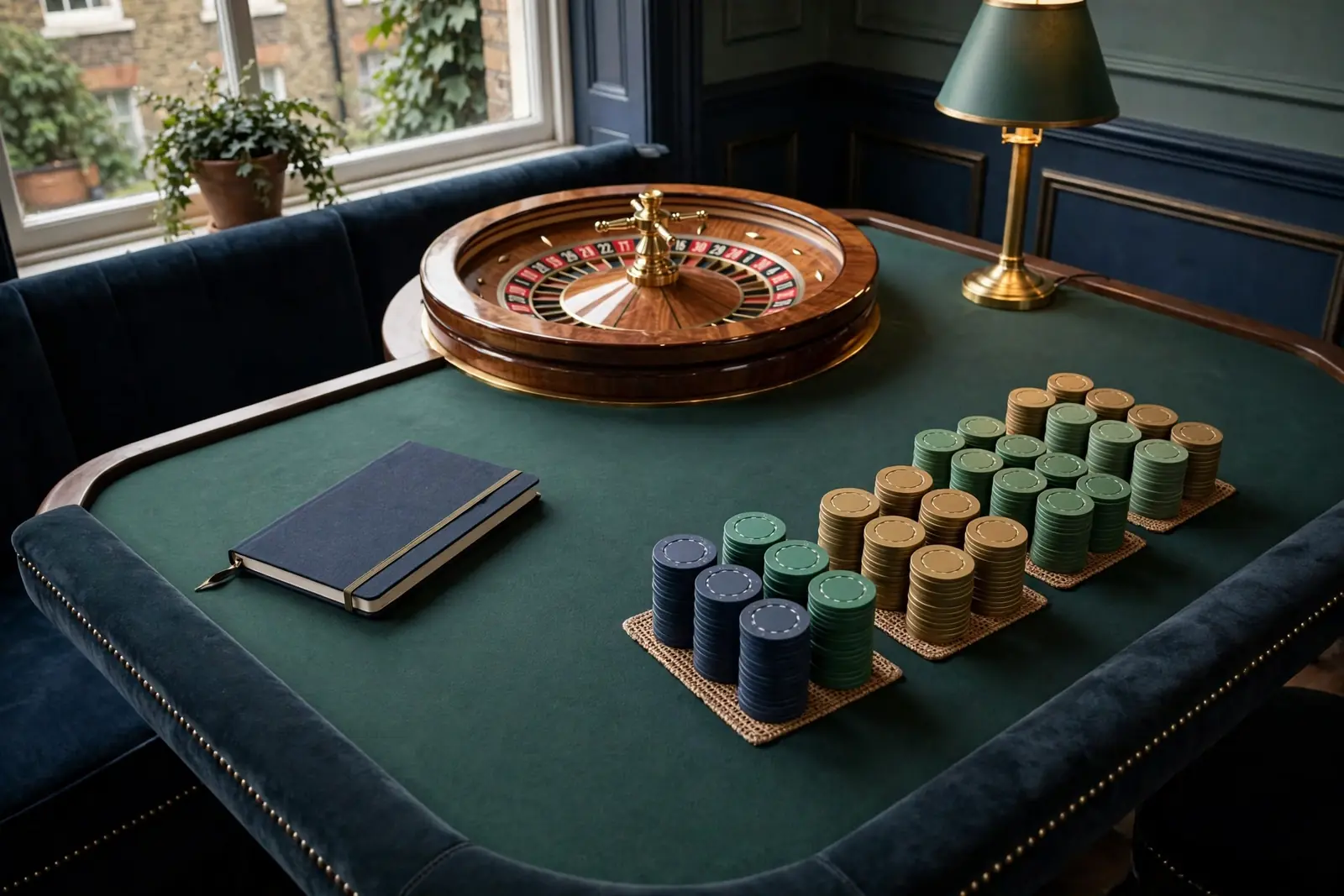
French Roulette Online in UK Casinos: The Zero
 Available in GB
A practical guide to the single-zero wheel, table features, bet payouts and conditions that can affect roulette play.

Table of Contents
- French Roulette’s Zero Changes the Maths
- What Makes a French Roulette Table Worth Playing?
- Live French Roulette: A Real Wheel, Not a Simulation
- Low-Stakes French Roulette Without the Guesswork
- The Bets and Payouts You’ll See on the Online Table
- Bonus Wagering: Read the Roulette Contribution Carefully
- Premium Tables Still Need a Limit
- RNG, Live and Speed Roulette Don’t Move at the Same Pace
- Playing French Roulette Online Without Chasing Losses
- When a Roulette Variant Changes the Payout
French Roulette’s Zero Changes the Maths
The first thing I look at on a roulette wheel is the green pocket. Not because it is exciting, but because it changes the arithmetic behind every spin. A European wheel has the numbers 1 to 36 and one zero, making 37 pockets altogether. An American wheel adds a double zero, so the ball has 38 pockets to land in. That extra green space is the main reason the two versions do not treat a wager equally.
On a European-style wheel, each number has the same chance of being selected. The zero is not a pause in the game or a neutral result for the casino; it is a pocket that can decide a bet against you. American roulette has that same single zero plus the double zero. The extra pocket gives the house another route to an advantage, even though the numbered layout may look familiar when you first open an online game.
That difference shows up in the house edge: the built-in mathematical advantage the game has over time. European roulette’s edge is 2.70%, while American roulette’s is 5.26%. Those figures describe the long-run expectation across play, not a prediction about what will happen in a particular session. A wheel does not remember what came before. I used to treat a run of reds as if it were a clue; it wasn’t. The next spin still has its own random result.
When choosing a UK casino for French roulette, payout information can be one useful point to consider. Use these verdicts as a brief reference when deciding what to check.
Payout speed: 1-3 business days Jetsetspins lists a payout speed of 1–3 business days. Check whether its French roulette offering suits you.
Payout speed: 1-3 business days x3bet lists a payout speed of 1–3 business days. This is the available detail to consider when reviewing it for French roulette.
Payout speed: 1-3 business days Revery Play lists a payout speed of 1–3 business days. Check its French roulette offering to see whether it fits your needs.
Payout speed: 1-3 business days Zombillion lists a payout speed of 1–3 business days. That payout information may be useful as you assess it for French roulette.
Payout speed: 1-3 business days NightLuck lists a payout speed of 1–3 business days. Consider this detail alongside whether its French roulette offering suits you.
Payout speed: 1-3 business days Amunbet lists a payout speed of 1–3 business days. Check its French roulette offering for details relevant to your choice.
Payout speed: 1-3 business days WinBeast lists a payout speed of 1–3 business days. This is the stated detail to keep in mind when considering it for French roulette.
Payout speed: 1-3 business days Chanze lists a payout speed of 1–3 business days. Check whether its French roulette offering meets your preferences.
Payout speed: 1-3 business days EvoSpin lists a payout speed of 1–3 business days. You can use this payout detail as one point of reference when reviewing it.
Payout speed: 1-3 business days NightWin lists a payout speed of 1–3 business days. Check its French roulette offering to decide whether it is suitable for you.
It is tempting to look only at a bet’s advertised payout and decide that the two wheels are much the same. A winning straight-up number pays 35:1 on both European and American roulette, but that matching payout does not erase the difference in the number of pockets. On the American wheel, the double zero adds another losing outcome for a single-number bet without changing that payout. The extra pocket is easy to overlook on screen. The maths doesn’t overlook it.
French roulette is associated with the single-zero wheel, and its rules can make some wagers more favourable than the standard European calculation. The detail that matters most for a simple comparison is La Partage. If the ball lands on zero, half of an even-money bet is returned rather than the whole stake being lost. Even-money bets are the familiar choices that pay the same amount as the stake when they win, such as backing a colour or choosing odd or even.
That refund changes the effective house edge on those even-money bets to 1.35%. It does not remove the zero, and it does not turn the wager into a guaranteed return. If the ball lands on the other colour, or on the opposite parity, the bet loses as usual. If it lands on zero, the player gets half back under La Partage. The advantage comes from that less severe outcome, not from any ability to forecast where the ball will stop.

This is why “French” on a game label is worth reading as a rules clue, not just a decorative name. The wheel’s single zero gives you the European pocket count; La Partage can then soften the effect of zero for eligible even-money wagers. It is a narrower benefit than a blanket reduction on every type of bet. A wager on one number, for instance, is not an even-money bet, so the half-return rule described here does not apply to it.
When comparing French roulette with American roulette, I keep the two parts separate: first count the pockets, then check how a zero affects the wager I actually intend to make. The single-zero European wheel has the lower stated house edge overall than the American wheel. La Partage improves the calculation further for even-money bets when its rule applies. Those are related points, but they are not interchangeable: one describes the wheel and overall edge, the other changes the treatment of a particular class of wager.
For me, that distinction is more useful than a grand claim that one version is “better”. A lower house edge is a mathematical difference, not a promise that a session will go well, and the short run can look nothing like the long-run calculation. I’ve watched a favourable rule feel irrelevant after a quick run of losses. That feeling is real; it just isn’t evidence that the odds have changed.
Single-zero wheel with a house edge of 2.70%.
Double-zero wheel with a house edge of 5.26%.
Single-zero wheel where La Partage can reduce the house edge to 1.35% on even-money bets.
So, when an online French roulette game presents a single-zero wheel, the key comparison is straightforward: it has fewer pockets than the American wheel, and its stated European house edge is lower. If La Partage is in force, even-money bets receive an additional cushion when zero appears. Keep those details in view and the green pocket stops looking like a minor feature. It is where the difference begins.
What Makes a French Roulette Table Worth Playing?
I don’t judge a French roulette table by its gold trim, dealer camera or “premium” label. I look for the rules first. French roulette is attractive because La Partage and En Prison can reduce the house edge on eligible even-money bets when the ball lands on zero. Together, those rules give French roulette the lowest house edge among standard roulette variants. But the name alone doesn’t tell you what a particular table actually applies.
Check the rules displayed in the game before you place a bet. La Partage returns half of an even-money stake after a zero; En Prison can leave an eligible stake in play for the next spin under the table’s stated procedure. If either rule is absent, restricted or described differently, don’t assume you are getting the familiar French format. I’ve learnt to open the rules panel rather than trust the artwork. Small print matters.
Look for the actual game information
A table’s help or information panel should explain its rules and payouts, and make its return-to-player information accessible. RTP is a long-run theoretical measure, not a forecast for your session and certainly not a promise that you’ll get a particular amount back. It can still help you compare the stated maths of games, provided you are comparing like with like and have checked which rules are in force.

If the information is hard to find, unclear or seems inconsistent with what the table does, pause before playing. You can check the game’s own help pages and the operator’s terms, then contact customer support if something remains unclear. A polished lobby doesn’t answer a rules question. The rules do.
Also make sure you are looking at French roulette rather than a similarly styled European or American game. A familiar-looking layout does not establish that La Partage or En Prison applies. The difference is not decorative: it affects the terms of play. I’d rather spend a moment confirming the rule than discover it after a zero.
Check who is providing the game
In Great Britain, the UK Gambling Commission (UKGC) is the sole regulator of online casino activity. Operators offering real-money casino games to British customers must hold the relevant UKGC operating licence, regardless of where the company is based. A platform without a valid UKGC licence cannot legally offer real-money live roulette to British residents.
Before depositing, verify the operator’s licence number on the UKGC public register. That’s a practical check, not a box-ticking ritual. UKGC-licensed operators are expected to provide clear information about the game and access to an internal complaints process, with an approved Alternative Dispute Resolution service available if a complaint is not resolved. If you need to raise an issue, keep the relevant messages and records.
Age checks are part of the same basic framework: an operator must verify your age before allowing you to deposit. UKGC-licensed live casino operators must also offer deposit limits, loss limits, session time reminders, reality checks, cool-off periods and GamStop self-exclusion. Remote operators must prompt new customers to set a financial limit before their first deposit and provide accessible controls for account-level limits. These tools do not make a session risk-free, but they should be there to use.
Verify Table Safety
- Check for a valid UKGC licence number on the public register
- Confirm that age verification is performed before depositing
- Locate and set financial deposit and loss limits
- Ensure access to session reminders and GamStop self-exclusion
- Verify the availability of an internal complaints process and ADR service
Judge the table, not the sales pitch
When I compare tables, I ask myself a few plain questions: Can I find the rules without hunting? Are La Partage and En Prison clearly explained? Is RTP information accessible? Can I establish that the operator is UKGC-licensed and find its player-protection tools? If the answers are vague, I move on rather than treating the game’s presentation as evidence.
“Best” is a slippery word. A table may suit you because its rules are clear and its limits fit your plans, but no label changes roulette’s chance-based outcomes or guarantees a better session. I’ve mistaken confidence for evidence before. It wasn’t.
The operator’s account controls matter too. Look for the option to set or change limits before play, and know where to find time reminders and self-exclusion information. UKGC licensees are also required to contribute to the Research, Education and Treatment levy. That obligation sits with the operator; it is not a reason to raise your stake or assume a particular table is safer than another.
My shortlist is simple: confirmed French rules, accessible game information, a valid UKGC licence and visible player controls. If those checks hold up, you can assess the table on its stated terms. If they don’t, the elegant layout isn’t a substitute.
Live French Roulette: A Real Wheel, Not a Simulation
The clearest difference between live French roulette and a computer-generated table is what you see on screen. A studio camera shows a real roulette wheel, a human dealer sets the game in motion, and the ball physically drops into a pocket. You are watching a streamed table rather than an animation generated by a random number generator.

I like that visible sequence because it makes the game feel less abstract. You can follow the dealer’s actions and watch the wheel turn, instead of seeing only a result appear on a digital layout. But the camera does not make the outcome predictable. A convincing studio, a familiar dealer or a run of results that looks meaningful cannot tell you where the next ball will land. It is still chance.
Before joining a live French table, I would check that it is actually French roulette. A live stream describes how the game is presented; it does not, by itself, tell you which roulette rules apply. Read the table information and look for the rules and payout details there. If you want the French version, the title and rules should make that clear rather than leaving you to infer it from the wheel or the dealer’s presentation.
The same caution applies to a table labelled “auto”. A label alone does not tell you whether you are watching a studio-streamed wheel with a dealer or using an automated format. Check what the table says about how play is delivered. Those formats can look similar in a casino menu, but they are not the same experience. Small detail. Worth checking.
There is also a less visible part of the live experience: the protections attached to the operator. In Great Britain, a platform without a valid UK Gambling Commission licence cannot legally offer real-money live roulette to British residents. Before depositing, check the operator’s licence number on the Commission’s public register. A familiar-looking stream is not proof of a licence.
A live stream describes how the game is presented, but it does not confirm which roulette rules apply. Always check the table information for specific rules and payout details.
A UKGC-licensed operator must verify your age before letting you deposit. It must also prompt new customers to set a financial limit before their first deposit, and provide accessible account controls for changing limits. Live casino operators must offer deposit limits, loss limits, session time reminders, reality checks, cool-off periods and GamStop self-exclusion. I would check where those controls sit before play, not wait until I’m annoyed or distracted to go looking for them.
Table information matters too. RTP details should be accessible for roulette offered by UKGC-licensed operators, so look for them in the game or help information rather than relying on a promotional label. If something goes wrong, the operator must have an internal complaints process and access to an approved Alternative Dispute Resolution service. That gives you a route to raise a dispute; it does not mean every complaint will go your way.
For me, the appeal of an online live French roulette casino is the human, visible format: the dealer, the real wheel and the ball’s drop. The sensible check is whether the table is genuinely the French game you want and whether the operator’s protections are easy to find. A polished studio is nice. The rules and safeguards matter more.
Low-Stakes French Roulette Without the Guesswork
A low table minimum is a way into a game, not a safety feature. I learnt that the hard way: when each wager feels small, it is easy to keep playing without noticing how many decisions you have made. The figure beside the table tells you the smallest stake it accepts. It does not tell you what a session will cost.

The first thing to check is the format. RNG roulette uses a random number generator to produce simulated spins, and its minimum stakes are often lower than those at live tables. Some RNG games accept wagers as low as 10p. That can make it easier to try a French roulette layout without committing to a larger stake, but the quicker, self-directed play can also make it easy to place another bet straight away.
Live tables are a different proposition. A specialist review reports UK live roulette minimums starting at 10p, with auto-roulette and speed roulette formats sometimes starting at 5p. Treat those as reported entry points, not a promise about every table you open. The minimum can differ between games, so check the table information before joining and again before confirming your wager.
Auto-roulette still uses a physical wheel, but the process is automated rather than led by a dealer. Speed roulette is designed to move quickly. Neither label tells you what the minimum is: the listed stake does. If you want to keep the entry point low, compare the minimum on the exact table, rather than assuming that live, auto or speed play always costs more or less than RNG roulette.
Set your limit before the first spin
Before depositing, decide what amount you are prepared to lose and set an account-level limit that supports that decision. UKGC-licensed operators must prompt new customers to set a financial limit before their first deposit and provide accessible controls to manage account limits. A table minimum can help you choose the size of each wager; it cannot replace that broader boundary.
- Set an account-level limit before your first deposit
- Decide on a stopping point before opening the game
- Verify the total stake on the bet slip
- Use a low table minimum as a replacement for a budget boundary
- Treat a table minimum as a target for wagering
- Click through wagers on autopilot
I would also decide when to stop before opening the game. A low stake can still add up when you keep returning to the table, especially if you treat a minimum as a target rather than a floor. If the table’s minimum does not fit the limit you set, leave that table alone. You do not have to make a game fit your budget.
Check the unit and the bet slip, too. The amount shown for a table may be the minimum per wager, while the layout can let you place more than one wager at a time. Make sure the total you are about to stake matches what you intended. It is a small pause, but it has saved me from clicking through on autopilot.
Low stakes, with eyes open
There is no need to chase a table advertised as “low limit”—that phrase only describes an entry point. Look for the actual minimum, confirm the stake shown on the bet slip, and use the account controls to keep your spending within the boundary you chose. If you cannot find the table’s limits clearly, do not guess.
For British players, real-money online casino play belongs at UKGC-licensed operators. Age must be verified before an operator allows you to deposit. Those checks do not make roulette predictable, and a small minimum does not make a session harmless. Keep the two ideas separate: the table determines what you can stake per wager; your own limit determines when you stop.

The Bets and Payouts You’ll See on the Online Table
The layout can look busy until you separate it into two areas. Inside bets sit on the numbered grid; outside bets are placed in the boxes around it. On an online French roulette table, you select a chip value, then click or drag your chips onto the relevant spot. Before confirming, check that the chip has landed where you intended. I’ve misread a cramped layout before. Annoying, but avoidable.
Inside bets: choosing numbers
A straight-up bet goes on a single number. If the ball lands there, the stated payout is 35:1. It is the most direct bet to understand: one chosen number, one result that wins. The payout is high compared with an outside bet, but the chance of that number coming up is correspondingly small. A larger payout is not a promise of a better chance.
A split bet covers two adjacent numbers. Place the chip on the line between them, rather than in the middle of either number’s box. Its stated payout is 17:1. That small placement detail matters on a touchscreen: if the chip snaps to one number instead, you have made a different bet.
A street bet covers a horizontal row of three numbers. The chip goes at the edge of that row, in the designated street area, and the stated payout is 11:1. Look closely at the table’s betting markers before tapping. The numbers may appear close together, and a chip dropped on a line can mean something different from one placed inside a box.
Those are useful examples of how the inside area works: a bet can cover one number or a group, and the payout changes with the bet type. The table’s display should show your selected wager and the places it covers. Take a moment to verify both before the betting window closes.
Placing Inside Bets
Choose the chip denomination you wish to use for your wagers.
Click or drag the chip onto a single number (straight-up), the line between two numbers (split), or the edge of a row (street).
Check the table’s display to ensure the selected wager and the covered numbers are correct before the window closes.
Outside bets: covering broad groups
Outside bets sit beyond the numbered grid and cover larger categories. Red or black, even or odd, and high or low each pay 1:1. They are easier to read at a glance than a split or street, but they still depend on the result of the spin. The zero does not belong to red or black, even or odd, or high or low, so these bets do not win when it lands.
That last point is easy to overlook when the interface makes the outside boxes prominent. I used to treat a broad bet as though it covered nearly everything. It doesn’t. Check the category, then remember what falls outside it.
On a French roulette layout, the special rules can affect what happens to an even-money wager when zero appears. The table rules explain whether La Partage or En Prison applies; don’t assume the interface alone tells the whole story. Here, the useful habit is simple: know which box you selected and read the table’s rule for that bet before playing.
If you’re still learning online French roulette, start by identifying the bet area and payout shown on screen, not by placing several chips at once. A straight-up bet, split, street and outside bet each have a distinct position and stated return. Read the marker. Check the chip. Then decide.
Bonus Wagering: Read the Roulette Contribution Carefully
A French roulette table can look like a sensible place to use bonus funds, but the game’s contribution to wagering requirements may be quite different from its appeal as a game. The key term is game weighting: it tells you how much of each qualifying stake counts towards the requirement. A wager can be eligible without doing much to clear it.

The rate depends on the operator and the type of roulette. A review of UK casino bonus terms describes roulette contribution rates commonly falling between 10% and 20%. In the same kind of comparison, live roulette may count at 10% or 20%, while RNG roulette can count at 100%. Those are reported examples, not a rule you can assume applies to every offer. Check the terms attached to the specific bonus.
The difference matters. If live play has a lower weighting than RNG play, the same amount staked may make less progress towards the requirement at the live table. That doesn’t make RNG roulette the better choice for everyone; it means the bonus calculation is different. I’ve made the mistake of seeing a game listed as eligible and assuming all my wagers would count in full. They didn’t. Read “eligible” as permission to play, not a promise of full credit.
No-deposit offers deserve a closer read. A specialist review of such offers reports that some UK operators exclude live roulette from wagering altogether, while others apply a contribution rate from 0% to 10% when it is included. That range is specific to the terms described in that review, not a standard for every casino. If the wording says live roulette is excluded, playing it will not advance that bonus requirement.
Published terms can also change. A review of operator bonus conditions has reported live roulette contribution rates of 10% to 20% for PartyCasino and Gala Casino. Treat those figures as a snapshot of listed terms, not a standing promise: check the current offer and its full rules before you opt in. Look for separate entries for live roulette, RNG roulette and no-deposit bonuses rather than relying on a general statement about casino games.
Attention: A game being listed as “eligible” for a bonus is permission to play, not a promise that all wagers will count in full towards wagering requirements.
There is also a UK-wide limit to understand. Since January 2026, the wagering requirement for bonuses at UKGC-licensed operators is capped at 10 times the bonus amount, according to a specialist review of the regulatory change. The cap does not mean every offer has that requirement, nor does it make a low game weighting disappear. You still need to check the offer’s own requirement and which roulette wagers count towards it.
I now check the game-weighting table before I deposit, then read the exclusions and any conditions tied to bonus funds. If the terms are unclear, I don’t treat the most generous interpretation as the right one. Small print matters.
Premium Tables Still Need a Limit
A “premium” label can make a roulette table look like a step up: more polished presentation, higher stakes, perhaps a sense that the game is meant for serious players. I’ve been drawn in by that framing before. It changes how the table feels, not the chance of where the ball lands. A VIP badge does not improve the odds or promise a better session.
Table minimums vary. A specialist review reports that UK live roulette tables can start at 10p, while auto-roulette and speed roulette formats sometimes begin at 5p. Those are entry points, not a recommendation to stake more, and they don’t tell you what a particular premium table will require. Check the displayed minimum and maximum before joining; if the minimum already feels uncomfortable, leave that table alone. No status is worth stretching your budget for.

I used to set a limit only after I’d started playing, which is a tidy way to let the table make the decision for you. Set account-level limits first. UKGC-licensed operators must prompt new customers to set a financial limit before their first deposit and provide accessible controls for managing account limits. They must also offer deposit and loss limits, session reminders, reality checks, cool-off periods and GamStop self-exclusion. Use the controls that fit your needs, rather than treating them as emergency buttons.
Before depositing, verify the operator’s licence number on the UK Gambling Commission’s public register. Platforms without a valid UKGC licence cannot legally offer real-money live roulette to British residents. Operators must verify your age before allowing you to deposit, and a UKGC-licensed casino must provide an internal complaints process and access to an approved Alternative Dispute Resolution service.
Premium tables are still roulette. If you choose one, decide your spending boundary away from the table and keep it there. A higher limit is not a measure of skill, and it does not make losses easier to absorb. The label is decoration. Your limit is real.
RNG, Live and Speed Roulette Don’t Move at the Same Pace
The main difference between roulette formats is not just whether a real wheel is on screen. It is how often you have to make another decision. With faster spins, your balance can change more quickly simply because you get more chances to place a bet.
RNG American roulette is the quickest of these comparisons. A random number generator produces each result, and the game can run at 150 to 200 spins an hour or more. Live dealer roulette is slower: a real wheel and dealer bring the pace down to around 50 to 60 spins an hour. That gap matters. If you tend to place a wager on every round, the faster format gives you less breathing room between decisions.
Comparison of Game Pace
- RNG American Roulette: 150 to 200+ spins per hour
- Speed Roulette: Over 150 spins per hour
- Standard Live Table: 80 to 100 spins per hour
- Live Dealer Roulette: 50 to 60 spins per hour
Speed roulette sits in a different category from a standard live table. A specialist review reports that it can exceed 150 spins an hour, compared with 80 to 100 at a standard table. Treat that as a reported comparison, not a promise about every game: the pace you experience depends on the table and how quickly you choose to act.
An online French roulette game may be RNG-based or live, so the name of the roulette variant alone does not tell you how quickly rounds will arrive. Check the format before you join. If you want time to pause and reconsider, a live table’s slower rhythm may suit you better. If you choose RNG or speed roulette, decide in advance how long you intend to play; rapid rounds can make a session feel shorter than it is.
I have mistaken “quick” for “more fun” before. Mostly, it meant I had to keep making decisions with less time between them. Faster is a pace, not an advantage.
Playing French Roulette Online Without Chasing Losses
I understand the appeal of the Martingale. After a loss, you double the next bet, hoping that a later win will recover what went before. It sounds tidy when you describe it in one sentence. I’ve found that tidy systems can feel reassuring right up until the stakes start climbing.
That is the part the idea tends to hide. Each loss makes the next required bet larger, and a losing streak can put real pressure on your bankroll. A win later on does not make the earlier sequence harmless; you have still risked more as you tried to catch up. I used to focus on the recovery and ignore how quickly the plan could become uncomfortable. That was the mistake.
If you play French roulette online, treat each spin as a separate chance outcome, not a step in a pattern that owes you a win. Neither a run of losses nor a run of wins tells you what the ball will do next. No roulette system can predict the final result.
The practical move is to decide what you are prepared to lose before you start, then stop when you reach that point. Don’t raise your stake just because the last spin went badly, and don’t treat a doubling system as a way to make a loss certain to come back. Sometimes the clearest decision is to leave the table. No chasing.
When a Roulette Variant Changes the Payout
A roulette layout can look familiar while the payout rules underneath it have changed. I learned not to treat the printed numbers as the whole story: check the game’s rules before placing a bet, especially when a variant adds a feature such as a multiplier.
A specialist review of Lightning Roulette reports that a straight-up bet without a lightning multiplier pays 29:1, rather than the 35:1 associated with a standard single-number bet. The same review says outside bets keep standard roulette payouts. So the change is not simply “every bet pays less”; it depends on the type of wager and whether a multiplier applies. Read the specific rules on the table, not just the game name.
That distinction matters if you came looking for casino French roulette. Lightning Roulette is a separate variant, not French roulette with a new label. French rules such as La Partage and En Prison affect how particular bets are settled; a lightning feature changes the terms of its own game.
There is another separate comparison worth spotting on American wheels. A specialist review reports that some American roulette tables in UK online casinos have a third green pocket marked 000, giving the game a 7.69% house edge. That is a reported variation, not a description of every American table, and it is not French roulette either.
My old mistake was seeing a familiar grid and assuming familiar terms. Don’t guess. Check the payout display and rules before you commit a stake.
Published by the Candyland Casino 4 team.