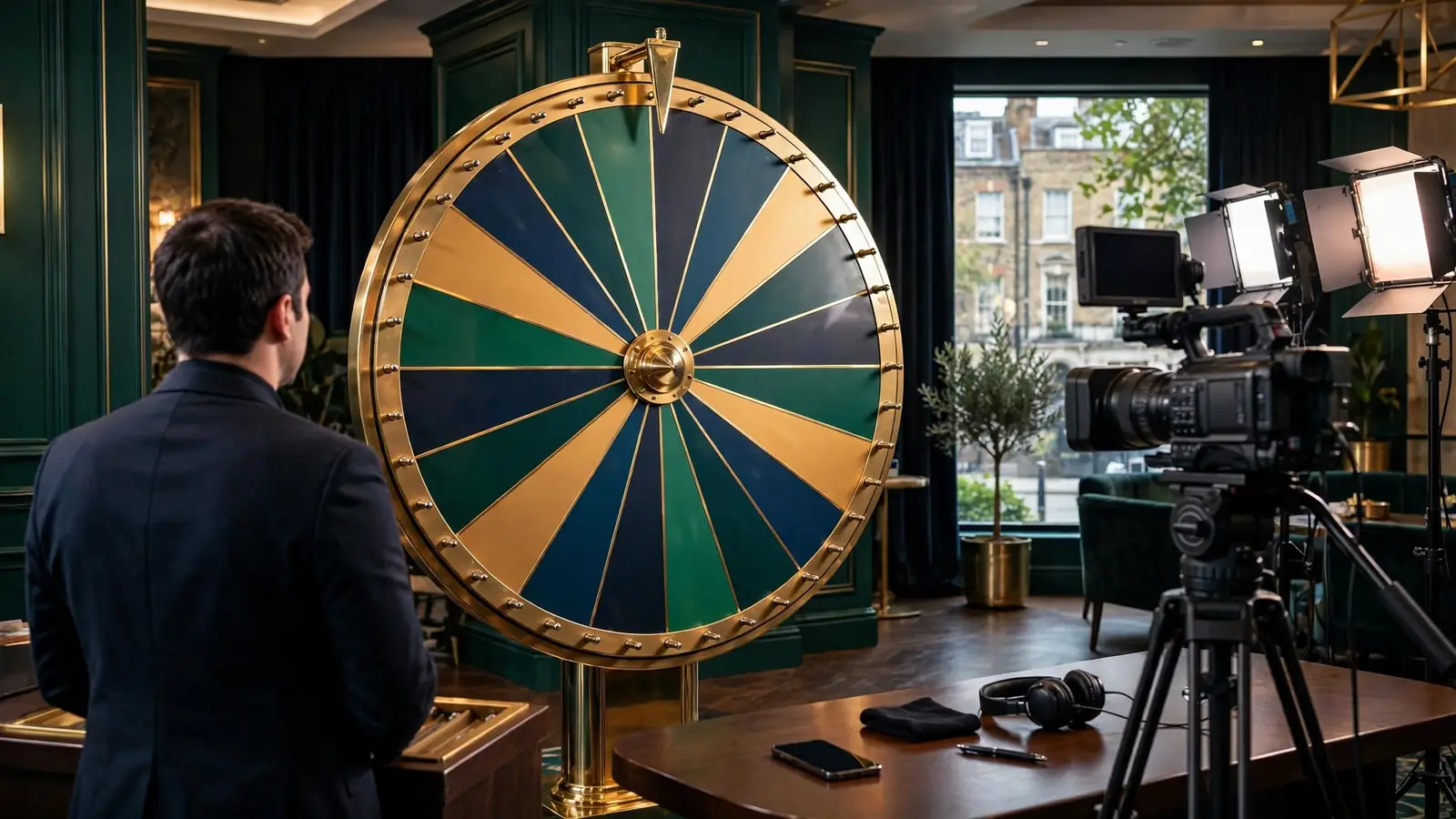
Deal or No Deal Casino UK: How the Game Works
 Available in GB
The show’s hidden-prize format is distinct from slot rules, demos, offers and the practical limits of playing online in Britain.

Table of Contents
- Deal or No Deal: the briefcase gamble behind the name
- Playing the online slot: qualification, Top Up and the main game
- Playing online in Britain: the practical limits to know
- Free play and demos: what you can check before risking money
- Golden Box Megaways and Double Action: what the names can—and can’t—tell you
- Free spins and Box Clever: check the actual game details
- What’s in Your Box? Offers, switching and the final choice
- Perfect Play: the final decision is still yours
Deal or No Deal: the briefcase gamble behind the name
The appeal of Deal or No Deal is easy to grasp: a briefcase holds a prize, but you do not know whether it is a good one. As other cases are opened, the possibilities narrow. Then the Banker makes an offer, and you have to decide whether to take a known amount or keep going with the hope that your own case contains more.
That is the familiar show premise behind the name. The tension is not just about what is hidden. It is about deciding how much certainty is worth when the alternative is still unknown.
The show begins with 16 briefcases. In the first round, three are opened, revealing their contents. The Banker then makes an offer, and the host asks whether the contestant will make a deal or continue. There are three Banker offers before the final stage. The contestant’s central choice is framed around the case still in their possession: will the amount in the last case to be opened be higher than the Banker’s offer?
If you’re weighing casino options around Deal or No Deal, payout timing is one practical detail to check. Use this list as a reference for the payment information available for each operator.
Payout speed: 1-3 business days Jetsetspins lists a payout speed of 1–3 business days, giving you a stated timeframe to consider.
Payout speed: 1-3 business days x3bet lists a payout speed of 1–3 business days, so you have a stated timeframe for payouts.
Payout speed: 1-3 business days Revery Play lists a payout speed of 1–3 business days, a useful detail for your payment planning.
Payout speed: 1-3 business days Zombillion lists a payout speed of 1–3 business days, giving you an indication of its stated payout timing.
Payout speed: 1-3 business days NightLuck lists a payout speed of 1–3 business days, which you can factor into your choice.
Payout speed: 1-3 business days Amunbet lists a payout speed of 1–3 business days, providing you with a stated payment timeframe.
Payout speed: 1-3 business days WinBeast lists a payout speed of 1–3 business days, giving you a clear stated timeframe to note.
Payout speed: 1-3 business days Chanze lists a payout speed of 1–3 business days, a practical detail for you to consider.
Payout speed: 1-3 business days EvoSpin lists a payout speed of 1–3 business days, offering you a stated indication of payout timing.
Payout speed: 1-3 business days NightWin lists a payout speed of 1–3 business days, which you can keep in mind when reviewing payment details.
That question gives the format its pull. The offer is visible; the contents of the case are not. Accept, and the contestant takes the certainty of the Banker’s amount. Continue, and the potential result remains unsettled. It is a simple choice to explain and a less comfortable one to make. I know how quickly a sure thing can start looking small when you imagine what might be inside the case. That feeling is part of the drama, not proof that continuing is the better decision.
When people look for a Deal or No Deal slot in the UK, they are often looking for that recognisable tension translated into an online-casino setting. The name points towards the show’s combination of concealed prizes, offers and a decision to stop or carry on. But a familiar title is not a promise that every detail of a television format appears in a particular casino game. The game’s own information is what tells you how that version works; the show premise is useful context, not a substitute for reading the rules.
That distinction matters because “Deal or No Deal” can sound like a whole experience rather than a reference to a format. The television contest has a host, a contestant and a sequence of decisions made in front of an audience. An online casino game is a gambling product with its own rules and outcomes. The shared language of cases, offers and choices can make the connection feel obvious, but it does not tell you what a particular game will pay, how often a feature appears or whether a decision gives you an advantage.

I’ve made the mistake of letting a familiar theme do too much work in my head. If I recognise the setup, I start filling in the gaps as though I already know the rules. That is how an entertaining idea becomes an assumption about a real-money game. Better to treat the title as a signpost, then separate the show’s premise from the specific rules of the slot in front of you. Familiar, not identical.
There is another piece of context: gambling online in Britain sits within a regulated market. The UK Gambling Commission is the regulator for commercial gambling in Great Britain, including online-casino activity. It issues operating licences to gambling businesses and personal licences to individuals who carry out relevant roles. For remote gambling offered to consumers in Great Britain, the operator’s location or the location of its key equipment does not remove the need to fall within the UK regulatory system.
That is more than a formal detail. The show’s question, “Deal or No Deal?”, is designed to make uncertainty entertaining. Real-money gambling adds a personal financial stake, so it is worth keeping the drama on the screen separate from decisions about your money. A dramatic offer is not a signal that the game is favourable, and a familiar format cannot tell you what your eventual outcome will be. The choice can feel like a test of nerve; it is still a gambling decision.
A dramatic offer is not a signal that the game is favourable, and a familiar format cannot tell you what your eventual outcome will be.
The phrase “Deal or No Deal casino UK 2026” brings those two ideas together: a familiar briefcase format and an online-casino game encountered in a regulated market. The year in a page title does not change the show’s basic premise or tell you what a specific game’s rules are. For that, look to the game information provided with the version you are considering. The broader idea is simpler: an offer gives you something certain to compare with a prize that remains hidden.
That is the briefcase gamble behind the name. The show makes the uncertainty visible and turns the decision into a memorable question. In a casino setting, the same theme may be recognisable, but recognition is only a starting point. Understand what is being offered, what remains unknown and which rules apply before treating the familiar drama as a guide to play.
Playing the online slot: qualification, Top Up and the main game
The online slot has a sequence to follow: qualify, decide whether to use Top Up, then enter the Deal or No Deal game. That matters because the familiar briefcase choice is not the whole slot. It is the later part of the feature, reached only after qualification.
The first thing to understand is the qualification condition. All three rings must land on a gold slice. It is not enough for one or two to do so; the condition applies to all three. If you are trying to work out why the main game has not started, this is the point to keep in mind. Qualification is a gate, not the briefcase round itself.

I find it useful to separate those stages in my head. The slot’s qualifying play decides whether you reach the feature; it does not mean you are already choosing between briefcases. Mixing those things together makes the game sound simpler than it is. There are two parts. First, qualify. Then, if the feature is reached, deal with the Banker and the briefcases.
Once qualified, you may use Top Up before playing the Deal or No Deal game. Top Up is optional, and its stated purpose is to add to prizes. That makes it a decision point rather than a condition of entry: qualifying comes first, then you can choose whether to use it, then the main game follows.
I would not treat the word “Top Up” as a promise that it must be worthwhile. It tells you the function described for the option, but it does not, by itself, explain what the addition costs, how it changes a particular prize, or what the likely result will be. Those are the kinds of details you should read in the game information before deciding. If they are not clear on screen, guessing is a poor substitute. I have learned that much the annoying way.
The main feature shifts the pace from the rings to the briefcases. As briefcases are opened in batches, the Banker makes offers. After an offer appears, the basic choice is whether to accept it or carry on. The offer gives you a point at which to stop; continuing means you remain in the game and face the next part of its sequence.
Game Sequence
All three rings must land on a gold slice to enter the feature.
Decide whether to use Top Up to add to the prizes.
Open briefcases in batches and decide whether to accept the Banker’s offers or continue.
There are four Banker offers before the final stage. That gives the feature a repeated rhythm: briefcases are opened, an offer arrives, and you choose whether to take it or continue. It is easy to focus only on the amount shown, but the decision is also about whether you want to end that game at the offer or keep going without knowing what the next offer or outcome will be. The game presents the choice; it does not make continuing a certainty of a better result.
Before the final stage, there is also a switch involving the two remaining briefcases: you can switch them before they are opened. That is part of the feature’s structure, not a separate way to qualify. Keep the stages distinct and the flow is easier to follow: the gold-slice condition gets you into the feature; Top Up is an optional step before it; offers and briefcases make up the game itself.
That order is the practical answer if you want to play the Deal or No Deal slot online and are trying to understand what happens next. A qualifying result does not skip the Top Up decision, and using Top Up does not replace the main game. The bonus feature still centres on the Banker’s offers as cases are opened, with the option to accept or continue. The final-stage switch belongs near the end of that sequence.

There is a familiar temptation to read each offer as a signal about what is hidden. I would keep that in check. An offer is a game decision, not a reliable hint that the remaining briefcases contain more or less. If you accept, the game ends on that offer; if you continue, you stay in the feature. Simple wording. A real choice.
For anyone searching for a Deal or No Deal casino game online, the key distinction is between reaching the feature and playing it. The rings determine qualification, Top Up can add to prizes if you choose it, and then the briefcase game begins. Once you know that chain, the slot makes more sense without treating every part as one continuous “deal” moment.
Playing online in Britain: the practical limits to know
The briefcase format can make a slot feel like a contest against the Banker, but the practical rules sit outside the game. Before I look at an online version, I separate two things: what the game’s help file says about its return, and what a UK-licensed casino must do when offering it for real money. Neither tells you what will happen in an individual session.
A specialist review reports that the game’s help file gives an expected return of 95.42%. Treat that as a figure attributed to the help file, not a promise about your results or a universal rate for every game carrying the Deal or No Deal name. RTP is a long-run statistical measure; it cannot tell you whether your next spin will win, or how much you will lose before a result arrives. I’ve made the mistake of reading a return figure as reassurance. It isn’t.
A specialist review reports that the game’s help file gives an expected return of 95.42%.
The speed of play is controlled
In Britain, an online slot cannot offer autoplay. You have to initiate each spin rather than setting the game to repeat spins unattended. That matters more than it may sound: autoplay can make a session run on while your attention drifts, whereas manual play leaves a decision between game cycles.
There is also a minimum interval for each online slot game cycle. At least 2.5 seconds must pass from the start of one cycle before another can begin. This is a regulatory rule, not a setting you can switch off to make a game faster. A slot’s animations may take longer, but they cannot be used to make the next cycle start sooner than the permitted interval.
I prefer to treat that pause as a chance to check in with myself, not as an invitation to hurry into the next spin. Small distinction. Useful one.
Stake caps apply to each game cycle
The maximum total stake for an online slot game cycle depends on your age. If you are aged 18 to 24, the cap is £2 per cycle. If you are 25 or older, it is £5 per cycle. Those are maximums, not recommended stakes, and a casino may let you choose less. A game’s individual controls do not override the legal cap.
When checking a Deal or No Deal slot machine online, look at the stake shown for the full cycle before you play. The relevant amount is what you stake on that cycle, not how dramatic the animation feels or what the Banker offers in a bonus. I would not assume that a familiar television format makes the money side easier to manage. It is still gambling, and a losing run can arrive without warning.
Account checks and controls
A UK-licensed casino must verify your age before it allows you to deposit. It must also prompt new customers to set a financial limit before their first deposit and make account-level limit controls accessible. These are practical checks to notice when opening an account, rather than details to leave for later. If a site asks you to set a limit, choose one that reflects what you can afford to lose; changing it should not be treated as a way to chase a session.

Licensed operators must provide responsible-gambling tools, including self-exclusion. They must also offer an internal complaints process and access to an approved Alternative Dispute Resolution service. Those arrangements do not make a game safer by themselves, but they give you routes to use if you need to restrict access or raise a dispute.
For me, account controls are most useful when set before the game starts. Once you are caught up in a session, it is easier to talk yourself into changing the plan. That is not a clever strategy.
Check the operator, not just the game
The Gambling Commission regulates commercial gambling in Great Britain. An operator selling remote gambling to British customers must hold the relevant Commission licence, even if its equipment or business is based elsewhere. Online gambling is legal in the UK through appropriately licensed and regulated sites; a familiar game title alone does not establish that the casino offering it is licensed.
Licensing Check
Ensure the operator holds a Gambling Commission licence; UK-licensed casinos cannot accept credit cards for gambling.
Before depositing, check the operator’s licence on the Commission’s public register. A licensed casino should display its licence details and link to its register information. UK-licensed casinos cannot accept credit cards for gambling, and operators also cannot take wallet payments where the wallet would let credit-card funds be used for gambling. If a payment route seems to disguise credit-card funding, that does not make it acceptable.
These checks are separate from the slot’s own rules. Whether you are looking at a Deal or No Deal online casino game or another online slot, the same limits on speed, stakes and account protections apply. Read the game information, check the licence and set your boundaries before play. No game title changes those basics.
Free play and demos: what you can check before risking money
A free-play label can sound like a straightforward way to try a game before spending anything. I’d still pause over what the page actually lets you do. A description, a help file and an interactive demo are different things: reading information about a slot does not mean you can play it, and a free-play option should not be mistaken for real-money play.
If a casino displays a demo or free-play version of Deal or No Deal, check the page itself to see what is available. Don’t assume the title alone confirms that a playable version is offered, or that every site presents the game in the same way. The useful question is simple: can you actually open a no-stake version, or are you looking at promotional wording around the game? I’ve been too quick to treat a button or banner as a promise. Better to check first.

A demo, where one is offered, can help you get a feel for the interface and see how the game presents its information. It cannot tell you what will happen in a later real-money session. Nor does a free-play screen establish that a casino will offer a particular feature, variant or bonus. Keep the test modest in its purpose: familiarity, not a forecast.
What the help file can tell you
Game information is worth checking whether or not a demo is available. The help file is where I’d look for the rules and the game’s stated return, rather than relying on a short description or a phrase like “free slot game”. Those words tell you little about the actual conditions of play.
A specialist casino review reports that the game’s help files state an expected return of 95.42%. Treat that as a figure reported from the help files, not as a promise about what you will get back. Expected return is a long-run measure, not a prediction for an individual session. It does not say that a particular player will receive that proportion, or that trying a demo will reproduce the result of wagering money.
That distinction matters. A percentage can look reassuringly precise, but it cannot turn a chance-based game into a dependable way to make money. It also does not tell you whether a specific free-play screen is available, what it looks like, or whether it behaves exactly like a paid session. Those are separate questions.
- Read the help file for rules and returns
- Use no-stake demos to test the interface
- Treat a demo as a forecast of results
- Assume “free play” includes a money bonus
Free play is not the same as a free offer
People use “free play” to mean several things: a demo with no stake, a promotional offer, or simply an opportunity to look through the game’s rules. Those are not interchangeable. Read the wording around any option rather than assuming that “free” means there are no conditions or that a real-money bonus is attached.
I would not treat a mention of Deal or No Deal as confirmation of a particular promotion. If a casino advertises an offer, its own terms are what matter; the name of the game by itself does not establish eligibility, restrictions or value. For a demo, the immediate check is different: whether the page opens a playable version without asking you to stake money. Keep those two intentions apart.
This is also why I wouldn’t use a demo as a shortcut to judging whether a game is “worth it”. A few spins can make a slot feel lively or dull, but that impression is not a reliable measure of future results. It is easy to remember the entertaining part and forget that a short trial tells you very little about what a paid session might do. I’ve made that mistake with games before. The lesson stuck.
A practical check before you start
Before risking money, I’d take these steps:
- Open the game information and read the help file, rather than relying only on a banner or short summary.
- Look for an actual no-stake play option if trying the interface is your aim; don’t infer that one exists from the game title.
- Treat the stated expected return as statistical information, not a personal outcome or a guarantee.
- Keep promotional wording separate from the game’s rules, and read any offer terms directly before relying on them.
If there is no playable demo in front of you, the help file can still answer useful questions about the game. If there is a demo, it can show you how the presentation works. Neither replaces the other, and neither turns a session into a test of what you will win.
That’s the line I try to keep clear now: inspect what is actually available, learn what the game says about itself, and don’t let the word “free” do more work than it should. A demo can be a preview. It is not a promise.
Golden Box Megaways and Double Action: what the names can—and can’t—tell you
A title can sound like a specification. “Megaways” suggests one kind of slot, while “Double Action” sounds like another mode or a more involved version. But a name by itself does not tell you how a particular Deal or No Deal game plays, what features it contains, or how it performs. I’ve learned not to treat a confident-sounding label as a substitute for the game’s own details.
A specific named version of the game; rules and features should be verified in its own help panel.
A version of the game whose specific “double” mechanics must be checked via the game information.
A title whose specific layout and payout profile may differ from other Deal or No Deal versions.
That matters when you’re comparing titles such as Golden Box Megaways and Double Action. The words may help you distinguish one listing from another, but they do not establish the rules, bonus features, prize structure or expected return of either one. Nor can I treat the names as proof that every casino listing refers to an identical game. Before putting money into a game, look at the title and provider shown on the actual game screen, then open its help or information panel. That is where its own rules belong.
What a named version can tell you
A title can identify the version a casino is presenting. It can also give you a phrase to look for in the game’s information. That is useful as a starting point, not a verdict. If the listing says Golden Box Megaways, don’t infer a particular reel layout, number of ways to win, bonus round or payout profile from the label alone. The same caution applies to Double Action: its name does not explain what “double” refers to, or whether the game has any feature beyond the standard format.
A review has the same limitation. A heading that calls itself a Double Action slot review is not evidence about the game’s mechanics. Read what the review actually describes, and compare those details with the help file in the game you can access. If the two don’t line up, the in-game rules are the more relevant guide to the version in front of you. Marketing copy is not a rulebook.

I’m not saying the names are meaningless. They can help you find the right listing and avoid confusing one title with another. I’m saying they cannot carry more weight than the information behind them. A familiar brand may make a new title feel easier to judge than it is. I’ve made that mistake with games: recognisable wording can feel like useful knowledge, when it may only be packaging.
The Banker mechanic is not a variant feature list
The Banker’s offer is part of the broader Deal or No Deal format: as briefcases are opened, the player can be presented with an offer and choose whether to take it or carry on. That describes the central offer-and-choice idea. It does not confirm that Golden Box Megaways or Double Action uses a particular layout, adds a special round, or changes how prizes are awarded.
Keep those two questions separate. One is how the familiar Banker decision works in the general format. The other is what the named game in front of you specifically contains. A review that explains the first has not necessarily answered the second. When you want to know whether a named title has a feature, look for that feature in the title’s own rules rather than assuming it follows from the Deal or No Deal name.
The same applies to What’s in Your Box? A review of that title can help only if it identifies the game being discussed and explains its rules; the words “What’s in Your Box?” alone do not establish how it compares with Golden Box Megaways or Double Action. Similar branding is not proof of identical play.
A no-deposit bonus is an offer from the casino and is separate from the game’s own mechanics or title.
A bonus is separate from the game title
A no-deposit bonus is an offer from a casino, not a game mechanic that follows from the words Deal or No Deal. Seeing the game name beside a bonus phrase does not tell you whether an offer is available to you or what its conditions are. Those details belong to the casino’s own promotion terms. I would not treat a game listing, a review headline or a search result as confirmation of a bonus.
That distinction saves a lot of wasted assumptions. The game tells you what happens during play; a promotion tells you what an operator is offering under its terms. They may appear on the same page, but they are not the same thing.
So when a title catches your eye, use the name to locate the game, then check the game’s own information for its mechanics. For offers, read the operator’s terms separately. The label is a clue. Not proof.
Free spins and Box Clever: check the actual game details
Free spins and the name Box Clever can sound like clues to a particular promotion or slot feature. I’d be careful with that leap. A label alone does not tell you what a casino is offering, what game you would be playing, or what rules apply.
Free spins are a promotion, not the same thing as opening a game without wagering. If a casino advertises them, read the offer’s own terms before opting in: the details that matter are the ones attached to that specific promotion. Don’t assume a familiar Deal or No Deal title means a free-spins offer is available, or that an offer applies to every version carrying the name.

Box Clever needs the same separation between a name and a promise. I wouldn’t treat it as proof of a particular bonus, feature or game format. Check the title and information shown by the casino itself, then make sure they match what you intended to open. Names can catch your eye. They are not a rules page.
That distinction matters because a promotion and a game are separate things. A casino bonus may have its own conditions, while a game’s help file describes the game. One does not establish the details of the other. If you are deciding whether to play, don’t let a free-spins banner stand in for the game information or the promotion terms.
For the game’s expected return, the concrete figure in its help files is 95.42%. That is an expected-return figure, not a promise about what you will get in a session, and it does not explain the conditions of any promotion. I’ve made the mistake of reading an inviting label as if it answered both questions. It doesn’t.
So, if you want to play without staking money, treat that as a separate question from whether a casino is offering free spins. And if Box Clever is the title you have in mind, check the displayed game details rather than filling in what the name might suggest. Read the actual terms. No guesswork.
What’s in Your Box? Offers, switching and the final choice
The appeal of a What’s in Your Box-style game is the tension between what might still be hidden and what the Banker is willing to offer. As suitcases are opened, the Banker makes offers. You decide whether to take one or keep playing; the offer is a choice, not a promise that the value in your suitcase will be higher.
Suitcase Switching
You can change suitcases after the fourth Banker offer while the remaining cases are still unopened. This allows you to either stay with your original pick or take the other unopened case.
The timing of the switch matters. You can change suitcases after the fourth Banker offer, while the remaining cases are still unopened. Until then, you keep the case you began with. That gives the choice a real trade-off: stay with your original pick, or take the other unopened case without knowing what either contains.
I’d be wary of treating a switch as a clever way to improve the result. It changes which hidden prize you are playing for, but it does not reveal what is inside. The same goes for an offer: it gives you a definite amount to accept, set against an unknown outcome if you continue. Neither choice makes the uncertainty disappear.
Accepting an offer ends that game immediately. You collect the amount the Banker offered; you do not then carry on to open the remaining cases or also claim the prize in your suitcase. That distinction is easy to blur when the decision is presented as a dramatic moment. It is still a clear stop-or-continue choice.
If you are checking the return figure for a version described as What’s in Your Box, be careful not to assume that a number applies to every similarly named game. A specialist review cites a game help-file expected return of 95.42%. Treat that as a figure attributed to the help file, not as a guarantee of what you will receive in a particular session or proof that every version has the same return.
I’ve made the mistake of reading an offer as a hint about what the Banker thinks is in the cases. It is better understood as the amount on the table if you stop. Switch if you want to; accept only if you are content for that game to end there.

Perfect Play: the final decision is still yours
The last decision in a Deal or No Deal slot is not a trick to solve. It is a choice between certainty and uncertainty, and the right way to think about it is to be clear about what each option does.
You can accept the Banker’s final offer and end the game with that amount. Once accepted, the game is over; you do not also receive the prize in your briefcase. That distinction sounds obvious, but I have caught myself treating an offer as if it were a bonus sitting on top of the original prize. It isn’t.
Rejecting the offer leaves you with the prize in your own briefcase. You can also switch to the last unopened briefcase instead, making that case’s prize yours. Neither choice changes the offer into a guaranteed better result. One keeps your original case; the other replaces it with the remaining one.
That is the whole endgame: take the Banker’s amount, stick with your case, or swap. The suspense comes from not knowing which case contains the better prize. If you have a reason for preferring one option, make sure it is based on the game’s stated rules rather than a hunch dressed up as a system. I’ve made that mistake. It felt persuasive right until the reveal.
“Perfect Play” can sound like there must be a clever move that reliably beats the offer. The final choice does not promise that. You are deciding which uncertainty you are willing to live with, unless you accept the known amount and finish there.
Before choosing, pause long enough to separate the three outcomes in your head. Accepting ends the game for the offer; rejecting keeps your case; switching gives you the other unopened case. No hidden fourth route. No magic button.
There’s no universal answer that makes the decision right for every player. If the suspense is doing the thinking for you, step back and choose deliberately—or stop. That’s still your call.
Created by the ”Candyland Casino 4” editorial team.