
CandyLand Casino Complaints and Player Feedback
 Available in GB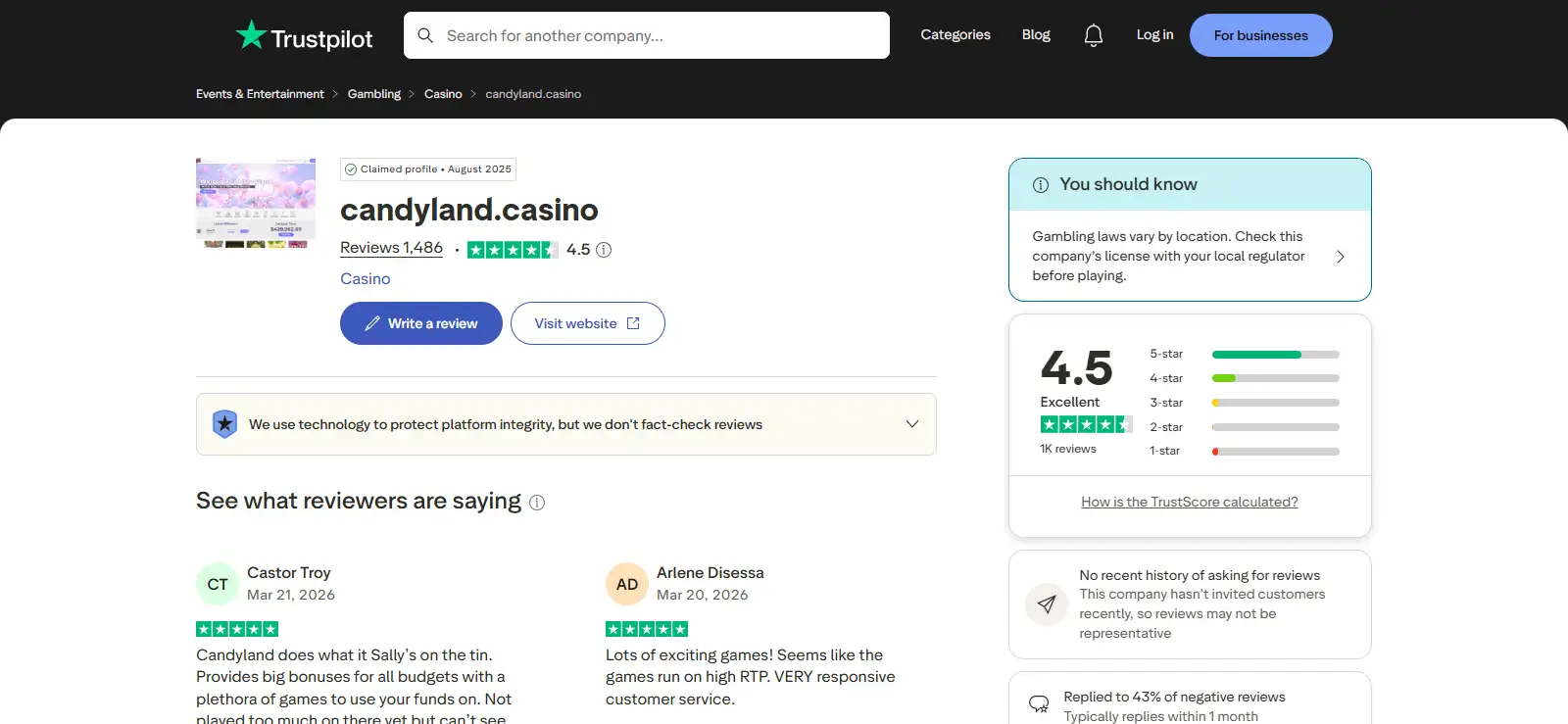
At the 21 August 2026 check, the candyland.casino Trustpilot profile displayed 1,486 reviews and a TrustScore of 4.5/5. Casino Guru’s current CandyLand complaint tracker displayed 13 cases in total: 0 opened, 2 unresolved, 2 resolved and 9 rejected. These are platform-level snapshots, not proof that any individual allegation is true or false.
The recurring issue worth examining is withdrawal friction. Current public feedback includes complaints about cashout delays and verification, while CandyLand’s official Terms state a withdrawal-processing target of 1 to 14 business days and separate weekly GBP limits for verified and unverified accounts. The right comparison is therefore between a player’s reported experience and the current official withdrawal rules, not between one review and a blanket “scam” or “safe” verdict.
Table of Contents
- Current review-platform snapshot
- What complaint themes are visible
- The official withdrawal terms are the factual benchmark
- How to read the Trustpilot score
- How to interpret Casino Guru complaint classifications
- What to document if you make a withdrawal
- Sample and moderation limits
- A simple evidence hierarchy for complaints
- Bottom line on CandyLand complaints
- Sources and date of check
Current review-platform snapshot
| Platform | 21 August 2026 snapshot | What it means |
|---|---|---|
| Trustpilot | 1,486 reviews, TrustScore 4.5/5 | A large body of user opinions and a platform score, not a regulator finding. |
| Casino Guru complaints | 13 total: 0 opened, 2 unresolved, 2 resolved, 9 rejected | Case classifications made under Casino Guru’s complaint process. |
Trustpilot also states that reviews are the opinions of individual users and not Trustpilot’s own findings. Its current profile notes that CandyLand has not recently invited customers to review, and the page displays a mix of ratings. Those details help describe the sample, but they do not validate the factual content of any one review.
Casino Guru uses its own complaint-resolution categories. A resolved complaint is one it classifies as successfully addressed. A rejected complaint can include cases where the player stopped responding, did not provide enough evidence or where the platform concluded the complaint was unjustified or outside scope. An unresolved classification reflects Casino Guru’s process and assessment, not a court or regulator judgment.
What complaint themes are visible
Withdrawal and verification issues are the clearest recurring themes in the current reputation material. Trustpilot includes recent users describing long waits for cashouts, while the Casino Guru complaint list contains multiple withdrawal-delay and verification-related case titles. The underlying accusations should not be treated as established facts. The repeated theme is still a useful signal to understand the official cashout framework before depositing.
That distinction matters because complaint platforms collect stories from people with different account histories, countries, payment methods, bonus use and verification states. Two reviews that both say “withdrawal delay” may describe very different situations. Without account records and the full chronology, a public review cannot establish whether a delay resulted from verification, a payment queue, a disputed term or something else.
For that reason, the most useful next step is not to count negative adjectives. It is to compare the theme with CandyLand’s own current rules.
The official withdrawal terms are the factual benchmark
CandyLand’s current Terms state that withdrawals may take 1 to 14 business days. For GBP accounts, the same Terms state a weekly withdrawal limit of £1,000 for verified accounts and £500 for unverified accounts. CandyLand also requires verification documentation before a pending withdrawal can be approved.
These facts do not prove or disprove a specific review. They establish the published baseline. A user saying that a request took more than two weeks raises a different question from a user who is still waiting for identity documents to be approved. A user attempting to withdraw more than the weekly account limit is also in a different position from one requesting an amount below the limit.
The dedicated withdrawal terms covers the current UK cashout rail, minimum, weekly limits, fees, processing target and other stated rules in detail. The verification requirements covers the current verification document requirements. Those pages are better factual references than a reputation score when you need to understand what the casino says should happen.
How to read the Trustpilot score
A 4.5/5 TrustScore across 1,486 reviews is a meaningful platform metric because it summarises a large set of submitted opinions. It is not the same thing as an audit of withdrawals, a licence check or a finding that every reviewer had a verified transaction. Trustpilot itself explains that reviews represent individual opinions and that a company’s displayed profile includes platform moderation and scoring processes.
The score also compresses very different experiences into one number. A positive review may focus on game choice, promotions or support rather than successful withdrawal. A negative review may be about a cashout, an account issue or a personal preference. That is why a reader should use the score as a broad sentiment indicator and then move to the specific topic that matters to the decision.
If cashout is your priority, the withdrawal Terms are more relevant than the average star rating. If regulatory status is your priority, use the licence and trust, where the current UKGC register result is handled separately from user feedback.
How to interpret Casino Guru complaint classifications
Casino Guru’s current tracker shows 2 unresolved, 2 resolved and 9 rejected complaints, with none currently opened in the displayed summary. The labels are useful because they distinguish outcomes inside that platform rather than treating every submitted complaint as a confirmed fault.
A rejected complaint should not automatically be read as evidence that the casino was right in every respect. Casino Guru’s own methodology says rejection can occur for several reasons, including insufficient evidence, the player stopping communication or the platform concluding that the complaint is unjustified. Likewise, an unresolved complaint records that the platform did not reach a resolution under its process; it is not by itself a regulator decision.
This is one reason long lists of complaint headlines can mislead. The status, evidence and procedural history matter. Platform counts are more useful for comparison than reproducing individual accusations that cannot be independently established.
What to document if you make a withdrawal
- Keep the withdrawal request date, amount and transaction reference.
- Save the current Terms that apply when the request is made.
- Keep copies of KYC requests and the dates documents were submitted.
- Record support-chat or email references without publishing personal data.
- Compare the request amount with the applicable verified or unverified weekly limit.
- Do not assume that a review-platform deadline replaces the casino’s published processing terms.
This record does not guarantee a particular outcome, but it creates a clearer timeline if you later need to understand what happened. It also makes a complaint more useful because the discussion can be tied to dates and published rules rather than memory alone.
Sample and moderation limits
Neither Trustpilot nor Casino Guru represents every CandyLand customer. People who post reviews are self-selecting, and the mix of users can change over time. Review platforms also apply their own moderation, scoring and case-resolution systems. A platform snapshot is therefore a sample of visible feedback at a particular date.
Country mix matters too. CandyLand reviews are not limited to UK residents, while the withdrawal rules can differ by currency or location. A complaint from another country may identify a general service theme but should not automatically be used to describe the exact UK payment route.
Dynamic metrics can also move quickly. The Trustpilot profile showed 1,486 reviews on 21 August 2026, so the number is presented as a dated snapshot rather than a permanent fact.
A simple evidence hierarchy for complaints
Use each source for the question it can actually answer. CandyLand’s published Terms are the baseline for stated withdrawal timing, limits and verification conditions. Review-platform totals and classifications describe visible sentiment and case outcomes on those platforms. Individual reviews describe personal experiences, but they do not establish what happened in another account. A reader’s own dated transaction and support records are the most useful evidence for reconstructing an individual withdrawal timeline.
Keeping those layers separate makes the reputation picture easier to interpret. A high platform score does not override a restrictive cashout term, while a negative allegation does not by itself prove that the published term was breached. The useful comparison is between the specific issue raised, the rule that applies to it and any dated account records available.
Bottom line on CandyLand complaints
The current reputation picture is mixed rather than reducible to one label. Trustpilot shows a high aggregate score across 1,486 reviews, while Casino Guru records 13 complaint cases with a mix of unresolved, resolved and rejected outcomes. Withdrawal and verification are recurring discussion themes, but individual claims remain anecdotal unless independently established.
For a UK reader, the most defensible approach is to use reputation data as an early-warning signal and official terms as the factual baseline. Read the cashout rules before depositing, complete KYC preparation early, and keep records if a withdrawal becomes disputed. For the separate regulatory question, use the licence and trust page rather than inferring licensing from either positive or negative reviews.
Return to the CandyLand review for the broader decision across bonuses, payments, games, mobile access, registration and trust.
Sources and date of check
On 21 August 2026, the platform figures came from the candyland.casino Trustpilot profile and Casino Guru CandyLand review and complaint summary. The withdrawal processing range, weekly limits and KYC requirement come from CandyLand’s current Terms and Banking material. Review totals change over time, so use the linked profiles for current figures.
Written by the editors at Candyland Casino 4.